
How to Check DeKalb County Criminal History
A useful DeKalb County criminal history search begins with the kind of record, not just a name. The Circuit Clerk Online Records page leads to the free Clericus Magnus case search for criminal, DUI, traffic, ordinance, conservation, and civil matters. Sheriff Records holds releasable arrest and booking material. Illinois State Police holds the statewide fingerprint-supported repository. The jail, VINE, IDOC, and the federal Bureau of Prisons each answer a different custody question.
Gather the full name, likely spelling, approximate event date, arresting agency, and case or report number if known. Date of birth can help distinguish people, but public portals do not expose every identifier. Read each result in context. A booking charge is an allegation at intake, while the circuit docket shows what prosecutors filed and how the court acted.
- Search the DeKalb County Circuit Clerk portal for a filed case and docket.
- Ask the arresting police agency for its incident or arrest report.
- Call the jail or use VINE when current custody is the key question.
- Use ISP Access and Review to inspect or correct your own Illinois transcript.
- Request a certified copy from the Circuit Clerk when proof of a court result is needed.
DeKalb Records Split Across Offices
One DeKalb County event may create several records. Police write the incident and arrest narrative. Jail staff create an intake and custody record. The State's Attorney decides whether to file a complaint, information, or seek an indictment. Circuit Clerk Lori Grubbs then maintains the case docket, orders, disposition, sentence, and assessments. Fingerprints and later court outcomes are reported to ISP's Bureau of Identification.
This split explains why two valid official sources can look different for a time. A jail record can display an intake allegation that was never filed. The court may show a reduced charge or dismissal that has not yet matched to the state transcript. For DeKalb County criminal records, the best source is the office responsible for the fact being checked.
| Question | Primary channel | Useful fallback |
|---|---|---|
| What did police report? | Arresting agency records unit | Illinois FOIA request |
| What was filed and decided? | DeKalb Circuit Clerk | First-floor criminal counter |
| Is the person in custody now? | Jail phone or VINE | IDOC after state transfer |
| What is on my Illinois transcript? | ISP Access and Review | Record Challenge process |
Official Illinois Background Checks
The Illinois State Police Bureau of Identification is the central criminal-history repository. Its Criminal History Information Response Process, called CHIRP, handles Uniform Conviction Information Act inquiries. CHIRP is not an open anonymous people search. Its login states that access is for Illinois law-enforcement agencies or organizations with an ISP User's Agreement. An electronic UCIA name inquiry costs $10, while a manual paper inquiry costs $16.
A name result is not fingerprint-confirmed. For self-review, use ISP Access and Review. A law-enforcement facility or licensed live-scan vendor captures fingerprints and identifiers, ISP mails the result, and the packet includes a Record Challenge form. ISP does not charge its processing fee for Access and Review, though a capture vendor may charge for service.
The official CHIRP information page explains the state name-based channel. Its interface shows why DeKalb County users should not mistake CHIRP for the county court portal.
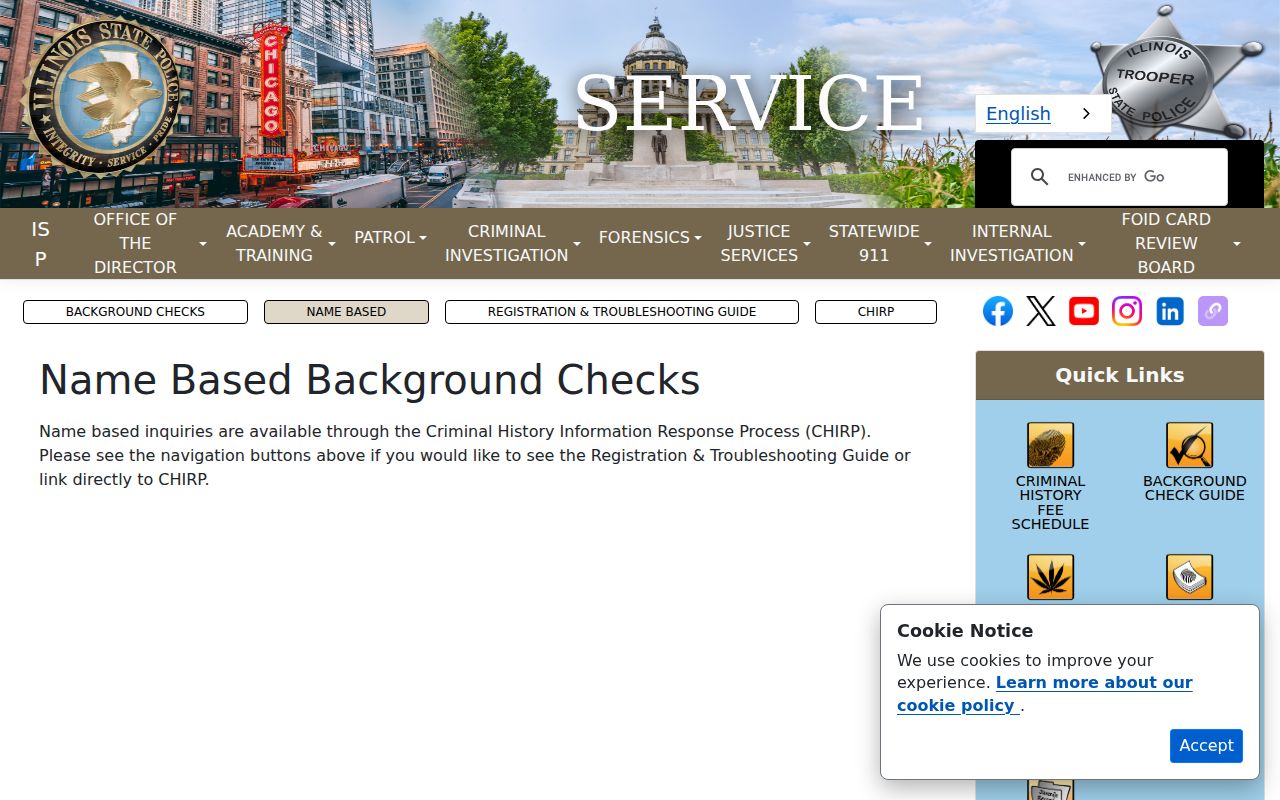
Use the circuit docket for a local case outcome and the ISP route for the state repository product.
CHIRP Access Has an Account Gate
The CHIRP login requires credentials tied to an approved agreement. Responses are later retrieved with the Transaction Control Number issued at submission. Because authentication hides the transaction form, no public field list should be inferred from another vendor or county. The known choice is more basic: use the proper approved CHIRP route for a UCIA conviction inquiry, or use ISP Access and Review for your own fuller transcript.
The official login capture makes that limit plain.
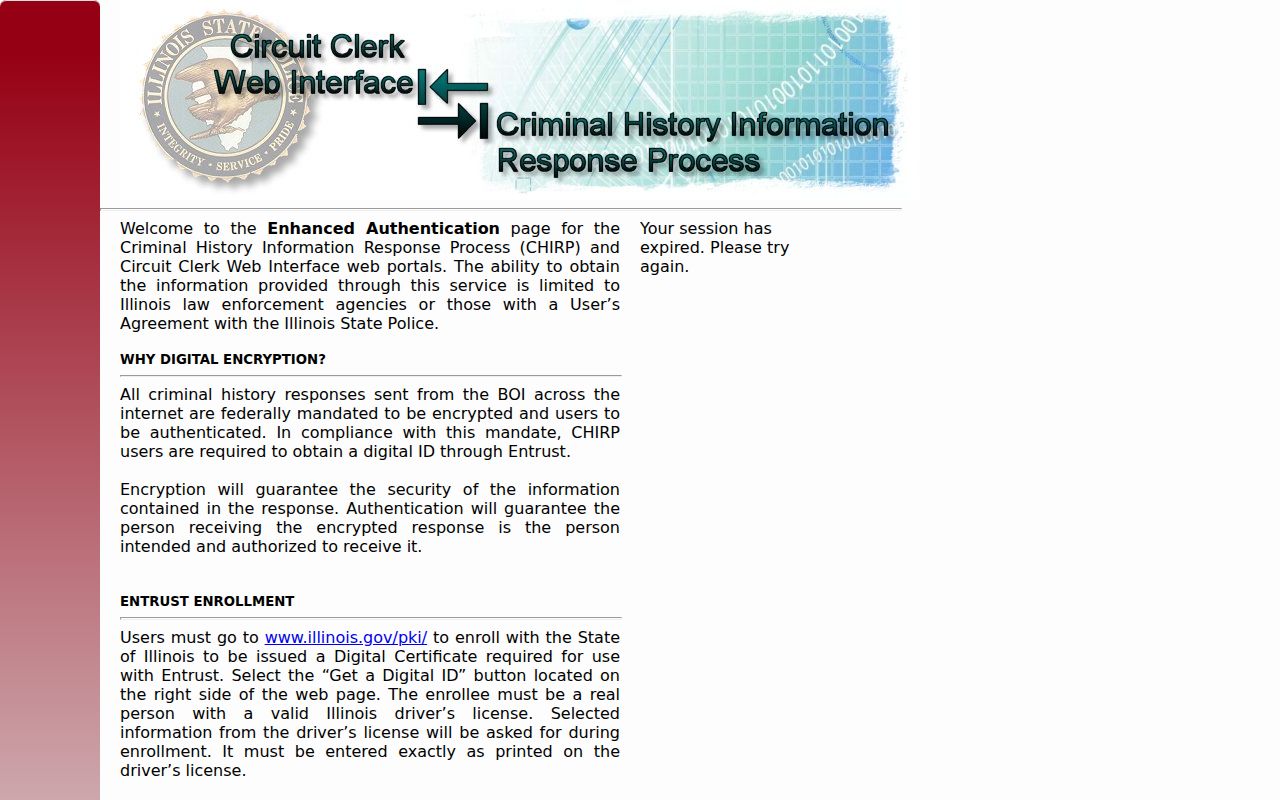
A searcher who only needs a DeKalb County charge and disposition will usually get a more direct answer from the Circuit Clerk.
Types of DeKalb County Criminal Records
DeKalb County criminal history is not one file. An incident report describes the agency response. An arrest report documents probable cause and custody. A booking record captures jail intake. Prosecutors create charging records, and the court maintains the filed case. ISP assembles fingerprint-associated Illinois arrest cycles and reported outcomes. Court Services keeps richer supervision files that are not presumed open simply because a public docket shows probation.
- Police records: incident, arrest, crash, dispatch, photo, audio, and body-camera material requested from the creating agency.
- Court records: filed charges, hearings, pleas, motions, orders, disposition, sentence, and financial assessments.
- Custody records: county jail booking, VINE notification, IDOC imprisonment, or federal BOP custody.
- Repository records: UCIA conviction responses and a subject's own ISP Access-and-Review transcript.
- Restricted records: juvenile, sealed, expunged, impounded, and protected-victim information.
No Public DeKalb Warrant Search
The county's official warrant application is marked for authorized local-agency users only. DeKalb County does not provide a verified public name-search warrant portal, and Illinois has no verified statewide public warrant search. An unofficial list is not a sound substitute. Call Sheriff non-emergency at 815-895-2155 for safe routing, or ask Sheriff administration and FOIA at 815-895-7260 or asullivan@dekalbcounty.org for releasable information.
Bench and failure-to-appear warrants can also appear in an underlying public court docket. Search the Circuit Clerk portal or call criminal and traffic staff at 815-895-7138. A person who thinks a warrant may exist should obtain case-specific instructions before appearing. A court order that resolves the case and the later clearing of an agency database entry are separate steps.
Authorized system only: The county warrant portal is not a public lookup. Confirm status through the sheriff and circuit clerk.
What a DeKalb County Criminal Record Shows
The fields depend on the record. An ISP transcript may contain identifiers, SID or FBI numbers, fingerprints, arrest cycles, statutes, reported outcomes, custody, and supervision entries. A DeKalb County court file commonly ties a case number and filing date to charges, appearances, hearings, orders, plea or verdict, disposition, sentence, and assessments. The county does not publish a verified person-level jail roster, so no online mugshot, housing unit, medical flag, or full date-of-birth field should be assumed.
| Name and identifiers | Legal name, aliases, birth information, and agency identity numbers where law permits. |
|---|---|
| Arrest and booking | Event date, arresting agency, intake allegations, booking time, custody, and release data. |
| Charges and laws | Alleged or filed offense, statute citation, and Illinois offense class. |
| Disposition | Dismissal, acquittal, plea, verdict, supervision, or another recorded outcome. |
| Sentence | Jail or prison term, probation, conditional discharge, restitution, fines, or costs. |
| Supervision | Probation, mandatory supervised release, parole, or custody status when reported. |
DeKalb Jail Records Need a Call
DeKalb County Jail uses a phone, VINE, and records-request model. No official public name roster or sheriff mobile app was found. For current custody, call the 24-hour line at 815-895-2155 or Corrections at 815-895-4177. County Pretrial Services points readers to VINELink for custody and case notifications. IDOC's locator applies only after transfer to state prison, not to present county pretrial custody.
Monthly jail reports are aggregate records, not person profiles. March 2025 materials reported an average daily population of 116, 157 new bookings, and one reactivated booking. A reactivated entry can follow a specialty-court violation and is not a new arrest. Those definitions matter when reading county workload data.
The official IDOC Individual in Custody Search shows why state custody must be checked apart from the county jail.
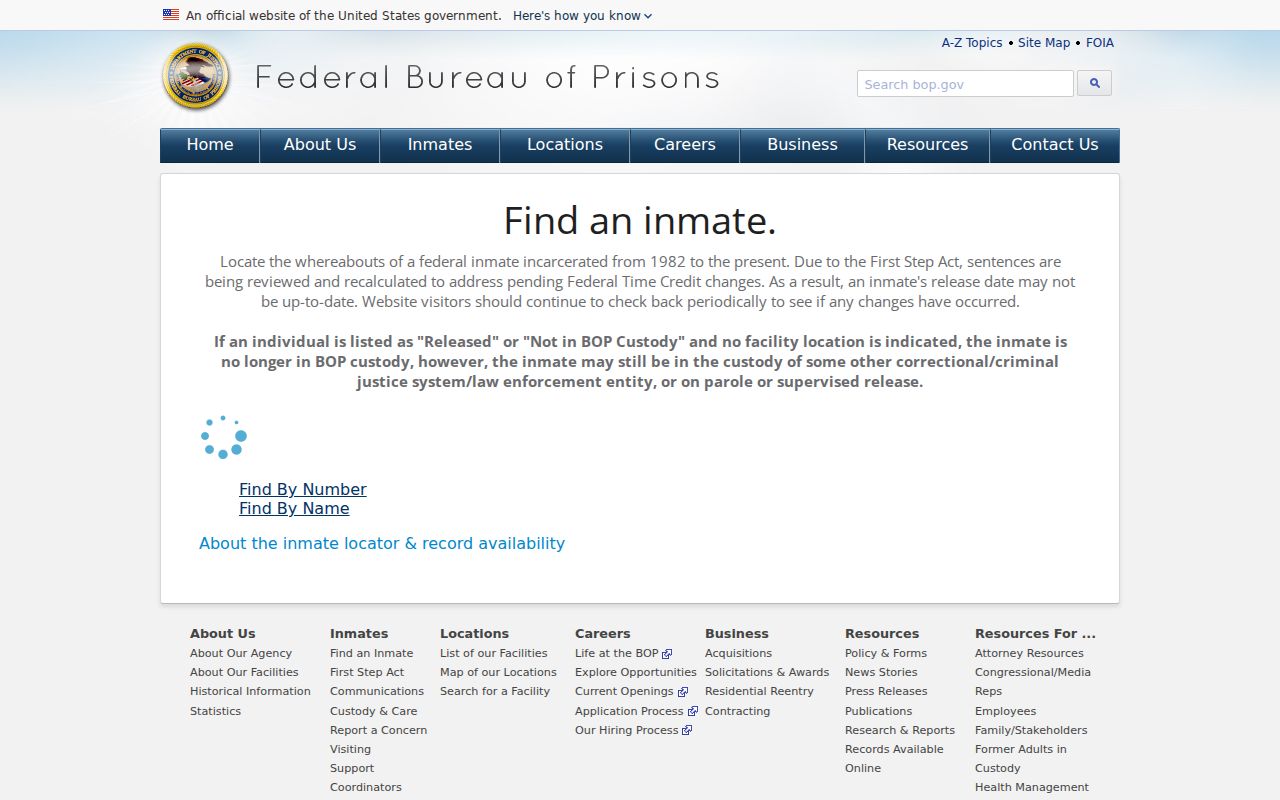
Federal custody is yet another layer, and the BOP locator covers federal records from 1982 onward rather than local jail stays.
Public Access Laws for DeKalb County Criminal Records
Illinois FOIA governs requests to executive agencies such as the sheriff and city police, but court records follow clerk and judicial rules. Public access does not mean every line is released. Active-investigation facts, juvenile material, victim information, personal identifiers, and security-sensitive content can be withheld or redacted. Remote court access is also narrower than access at the courthouse counter.
Key statutes and rules:
5 ILCS 140 sets Illinois FOIA request, fee, and exemption rules.
20 ILCS 2635 authorizes public conviction inquiries and correction duties.
20 ILCS 2630 governs arrest and disposition reporting plus clearing relief.
Illinois Remote Access Policy limits online access to sensitive court records.
DeKalb FOIA Requires PDF Attachments
County FOIA requests may be mailed, delivered, faxed, or emailed to the right department. An emailed request must attach the request as a PDF. A message written only in the email body will not be accepted. Sheriff Records can be reached at 815-895-7216. The general county form asks for requester contact details, a clear description, the department, the preferred inspection or copy method, and whether the request has a commercial purpose.
Ordinary noncommercial requests generally receive a response within five business days. The first 50 black-and-white letter or legal pages are free, then copies cost $0.15 per page. Color, oversize, electronic media, certification, and postage can cost the actual amount allowed by law. Requests should name each category, such as an arrest report, dispatch audio, photos, or body-camera footage, because each can have a different review and redaction path.
Sealed, Expunged, and Restricted Records
Expungement and sealing are separate Illinois remedies under 20 ILCS 2630/5.2. Expungement removes or obliterates eligible records as the statute directs. Sealing blocks ordinary public access but may preserve access for authorized agencies. Eligibility turns on each charge and outcome. Dismissals, acquittals, reversals, and many completed supervision outcomes can qualify for expungement, while a broader range of eligible convictions may qualify for sealing.
File the statewide form suite with the DeKalb Circuit Clerk at 133 West State Street in Sycamore or through eFileIL. The State's Attorney and agencies may object, and the court decides. ISP lists no petition-processing fee but charges $60 to process a court order; clerk fees are separate. Juvenile, impounded, protected-victim, and sensitive personal data remain restricted under their own rules.
After an order, allow time for each agency to update its system. If your ISP transcript still looks wrong, submit the order and clerk proof through Access and Review and Record Challenge.
DeKalb Live Scan Costs Vary
Illinois does not appoint one exclusive fingerprint company. Use the IDFPR licensed fingerprint vendor list, then confirm the appointment, identification needs, and capture charge with the vendor. No current official DeKalb County storefront fee was verified, so a local vendor address should not be guessed.
The official vendor-search screen is the proper starting point for DeKalb County fingerprint checks.
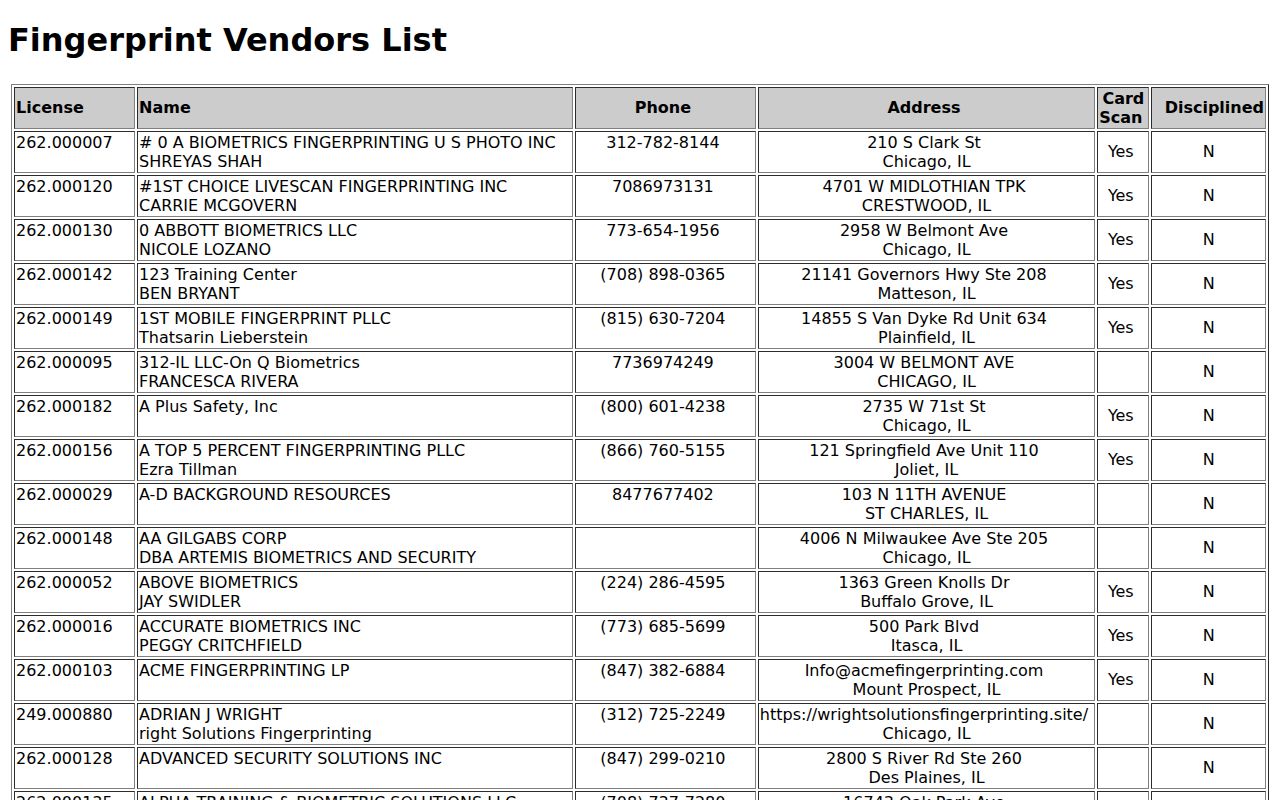
ISP's processing amount and the vendor's capture fee are separate charges.
| Submission | Paper | Electronic |
|---|---|---|
| State only | $20 | $15 |
| State and FBI | $32 | $27 |
| UCIA name inquiry | $16 | $10 |
| UCIA fingerprint card | $20 | $15 |
| Access and Review | No ISP fee | No ISP fee |
The ISP fee schedule supplies these state amounts.
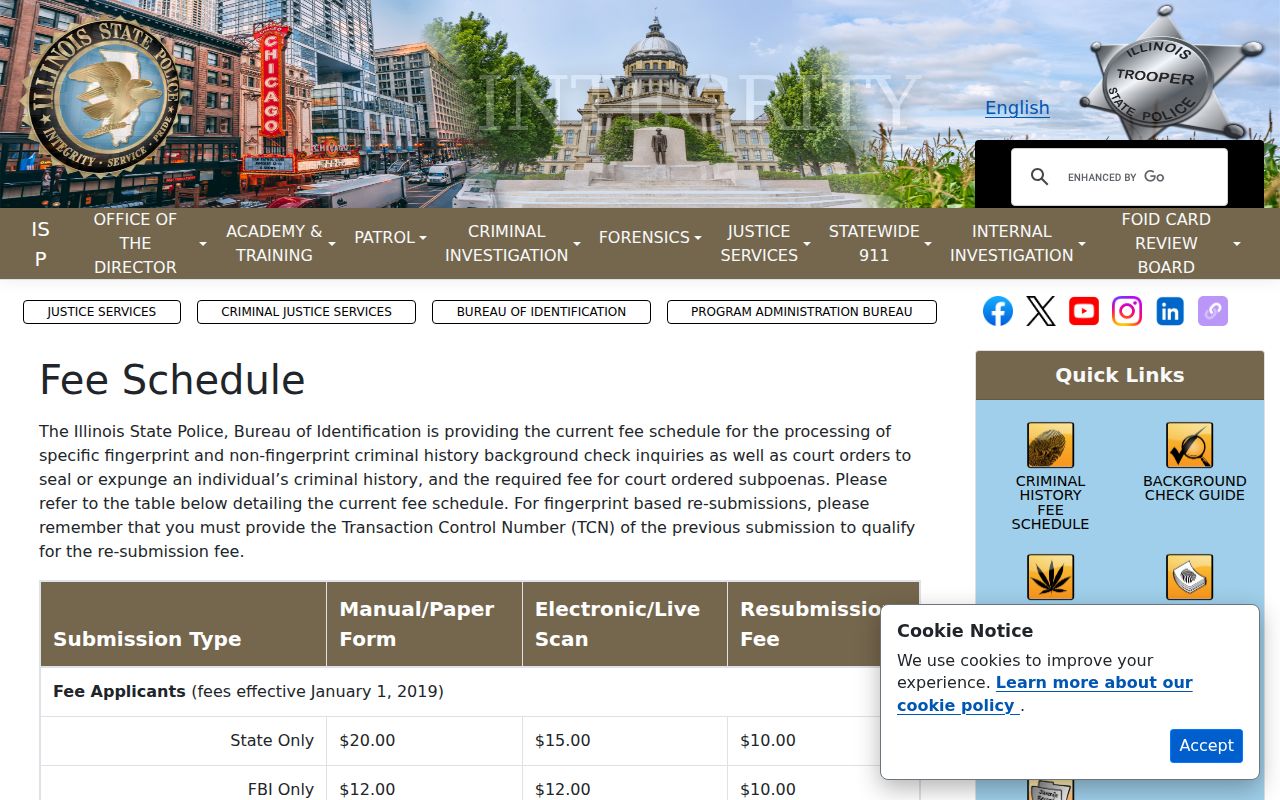
Always check the current state schedule before paying because the capture vendor may add its own service cost.
Criminal Records by City in DeKalb County
City police keep their own incident narratives even when a custodial arrest later reaches DeKalb County Jail and Circuit Court. The City of DeKalb also has NIU Police as a separate record holder. Sycamore places its police station close to the county justice offices, but the files remain distinct. Sandwich spans county geography, so the incident location can determine whether a case belongs in DeKalb or Kendall County.
DeKalb Criminal History
Population 40,467. City and NIU police reports route separately from county court files.
Sycamore Criminal History
Population 19,083. Police Records uses its own FOIA channel near the county seat.
Sandwich Criminal History
Population 7,380. Location can send custody or court records to a different county.
DeKalb Courthouse Records Span Generations
DeKalb County's present courthouse is the third county courthouse. The first court session took place in a clerk's home in 1837. A wood courthouse followed, then a brick building. The present structure was completed in 1904 and dedicated in 1905. Its restored limestone, marble, stained glass, bronze, brass, and woodwork make the records counter part of a long local civic history.
A 2012 secure addition added courtrooms, State's Attorney and Public Defender space, jury rooms, prisoner holding, and a sally port. Today, criminal and traffic work is handled on the first floor. The north entrance is accessible, and an elevator reaches all levels. That physical plan mirrors the legal split: public files are available through the clerk while custody movement and protected case work remain secure.